


HEPA vs. ULPA Filters: Which Is Right for You?
Contents
When building or upgrading a cleanroom, one of the most critical decisions you'll face is choosing between HEPA vs. ULPA filters. Both are high-performance air filtration systems, but they serve different purposes and come with distinct trade-offs.
This guide breaks down the key differences between HEPA and ULPA filters, their applications, and how to determine which filtration system makes sense for your facility.
What Are HEPA Filters?
HEPA stands for High Efficiency Particulate Air.
According to the U.S. Department of Energy, HEPA filters must remove at least 99.97% of airborne particles that are 0.3 microns in diameter. This 0.3 micron threshold isn’t arbitrary. It represents the Most Penetrating Particle Size (MPPS), which is the hardest particle size to capture.
HEPA filters are the industry standard for cleanroom applications ranging from ISO 5 (Class 100) to ISO 8 (Class 100,000). They're used extensively in:
- Pharmaceutical manufacturing
- Medical device production
- Food and beverage processing
- Electronics assembly
- Hospital operating rooms
- Research laboratories
The majority of cleanrooms worldwide rely on HEPA filters because they strike an optimal balance between air purity, operational cost, and system efficiency.
What Are ULPA Filters?
ULPA stands for Ultra-Low Penetration Air (sometimes called Ultra-Low Particulate Air).
ULPA filters take filtration to the next level. They must remove at least 99.999% of particles 0.12 microns in diameter or larger. That's more than eight times smaller than what HEPA filters are rated to capture, and significantly more particles removed overall.
This extreme filtration capability makes ULPA filters the go-to choice for the most demanding cleanroom classifications: ISO 3 (Class 1), ISO 4 (Class 10), and sometimes ISO 5 (Class 100).
Common ULPA applications include:
- Semiconductor fabrication
- Nanotechnology research
- Advanced pharmaceutical production
- Aerospace component manufacturing
- High-precision optics production
If your process involves nanoparticles, requires single-digit particle counts, or demands the absolute highest air cleanliness, ULPA filtration is likely necessary.
HEPA vs ULPA: Key Differences Explained
Think of HEPA vs. ULPA filters like two different engine options for a vehicle. ULPA is the high-performance racing engine. It is more powerful but requires more fuel, more maintenance, and costs significantly more to operate.
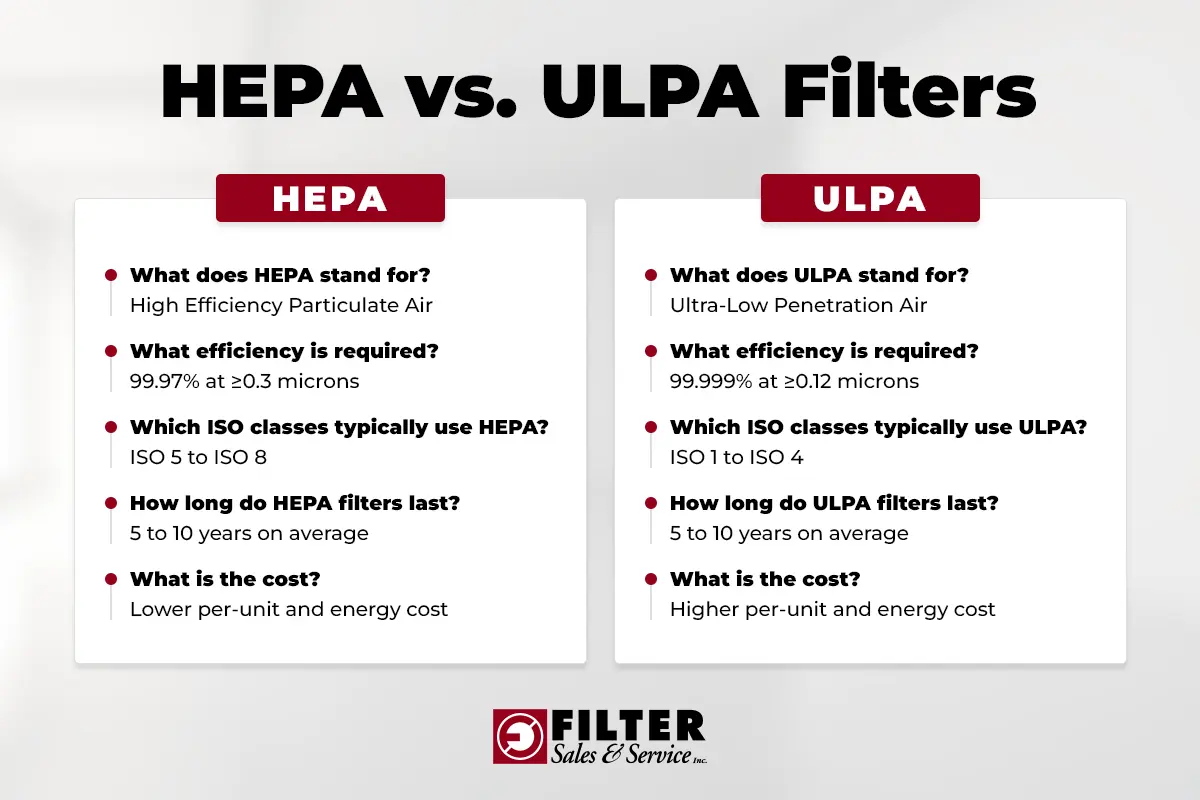
Here's how they compare across critical factors:
Filtration Efficiency
HEPA: 99.97% efficient at ≥0.3 microns
ULPA: 99.999% efficient at ≥0.12 microns
ULPA filters capture smaller particles and remove a higher percentage of all particles. For context, a human hair is about 70 microns in diameter. We are talking about particles hundreds of times smaller.
Filter Media Density
ULPA filters achieve their superior performance through denser filter media. More fibers packed into the same space means more opportunities to trap particles.
This density difference is where the HEPA vs. ULPA trade-offs begin.
Airflow Capacity
Denser media creates higher resistance to airflow.
ULPA filters typically pass 20-50% less air through the same surface area compared to HEPA filters. This means you'll need more ULPA filters to achieve the same air changes per hour (ACH) in your cleanroom, which is a critical metric for maintaining proper air cleanliness.
A 2,000 square foot cleanroom that requires 20 HEPA fan filter units might need 30 or more ULPA units to maintain the same air velocity and particle removal rate.
Pressure Drop
The pressure drop across ULPA filters is significantly higher than HEPA filters.
Higher pressure drop means your HVAC system works harder. You'll need larger blowers, more powerful motors, and ultimately more electrical energy to move air through the filtration system.
This translates to higher utility bills month after month, which is a cost that compounds over the years.
Initial Cost
ULPA filters cost considerably more than HEPA filters.
Depending on size and specifications, you might pay 50-100% more per filter. When you factor in needing more total filters to achieve proper airflow, the initial investment climbs quickly.
Operating Costs
Beyond the higher purchase price, ULPA filters cost more to operate:
- Increased energy consumption due to higher pressure drop
- More air conditioning required to remove heat generated by fan motors working harder
- Greater electrical infrastructure requirements
These ongoing costs often exceed the initial filter investment over the life of the cleanroom.
Filter Lifespan
Both HEPA and ULPA filters typically last 5-10 years depending on the application and environment. These high-efficiency filters have denser media which clogs faster, even with proper pre-filtration. This means more frequent changeouts, more labor costs, and more downtime for maintenance.
How HEPA and ULPA Filters Work
Both filter types use mechanical filtration rather than electrostatic attraction. As contaminated air flows through the dense fiber matrix, particles are captured through three primary mechanisms:
Impaction: Larger particles collide directly with fibers and stick.
Interception: Medium-sized particles traveling with airflow touch a fiber and are captured.
Diffusion: The smallest particles move erratically (Brownian motion) and eventually collide with fibers.
The 0.3 micron size for HEPA filters represents the most difficult particle size to capture. It is small enough to avoid impaction but large enough to resist diffusion. ULPA filters extend this performance to even smaller particles by using finer, more densely packed fibers.
Filter Selection Based on Cleanroom Class
When considering HEPA vs. ULPA, your cleanroom classification largely determines which type of filtration is appropriate.
According to ISO 14644-1 standards, cleanrooms are classified by the maximum number of particles per cubic meter of air:
- ISO 3 (Class 1): Requires ULPA filtration
- ISO 4 (Class 10): Typically requires ULPA filtration
- ISO 5 (Class 100): Can use HEPA or ULPA depending on specific requirements
- ISO 6 (Class 1,000): HEPA filtration standard
- ISO 7 (Class 10,000): HEPA filtration standard
- ISO 8 (Class 100,000): HEPA filtration standard
The vast majority of cleanrooms operate at ISO 5 or lower classifications, making HEPA filtration the most common choice.
When to Choose HEPA Filters
HEPA filters are the right choice when:
- Your cleanroom classification is ISO 5 (Class 100) or lower
- You need to balance performance with operational efficiency
- Your process doesn't involve nanoparticles or ultra-fine contaminants
- Budget constraints make ULPA filtration cost-prohibitive
- You want longer filter life and lower maintenance frequency
For most pharmaceutical, medical device, food processing, and general manufacturing applications, HEPA filtration provides more than adequate air cleanliness while keeping operational costs reasonable.
When to Choose ULPA Filters
ULPA filters are necessary when:
- Your cleanroom must meet an ISO 4 classification or higher
- Your process involves particles smaller than 0.3 microns
- Industry regulations specifically require ULPA-level filtration
- Product contamination risk justifies the higher operational cost
- You're manufacturing semiconductors, advanced optics, or nanotechnology products
Semiconductor fabs are the most common ULPA application. Even microscopic particles can ruin a wafer worth thousands of dollars, making the investment in ULPA filtration worthwhile.
Installation Considerations
Both HEPA and ULPA filters are typically installed in:
- Fan filter units (FFUs): Self-contained units with integrated fans that mount in the cleanroom ceiling plenum
- Ducted terminal filters: Filters installed at the end of HVAC ductwork
FFUs are the most popular configuration for modular cleanrooms because they provide independent airflow control and easier maintenance access. If you're new to cleanroom design, our guide on what cleanrooms are and how they work covers the fundamentals.
When designing your cleanroom, remember that ULPA installations require:
- More ceiling coverage (more filters needed for same airflow)
- Stronger structural support (more filters = more weight)
- Higher capacity electrical service
- More robust HVAC equipment
- Increased cooling capacity
These infrastructure requirements should be factored into your initial planning and budgeting.
Pre-Filtration Matters
Regardless of your choice in HEPA vs. ULPA, proper pre-filtration extends filter life and improves overall system efficiency.
Pre-filters capture larger particles before they reach your final filters. Filtration performance at this stage is typically defined by MERV rating classifications. Common pre-filter ratings include MERV 8, MERV 11, and MERV 14.
For ULPA installations, robust pre-filtration is especially critical given the higher replacement cost and shorter lifespan of ULPA filters. Even small improvements in pre-filtration can translate to significant savings over time.
Testing and Certification
After installation, HEPA and ULPA filters must be tested to verify performance.
Common testing methods include:
- DOP testing: Measures filter penetration using dioctyl phthalate aerosol
- PAO testing: Uses polyalphaolefin particles (modern alternative to DOP)
- Particle counting: Verifies particle concentrations meet classification requirements
- Airflow uniformity: Ensures consistent velocity across the filter face
Testing should be performed after installation, after filter changeouts, and annually (or as required by your industry regulations) to maintain compliance.
The Bottom Line: HEPA vs. ULPA
For most cleanroom applications, HEPA filtration delivers the performance you need at a reasonable total cost of ownership.
ULPA filters are a specialized tool for specialized applications. They're essential for the highest cleanroom classifications but come with significant cost penalties in initial investment, energy consumption, and maintenance.
Think carefully about your actual cleanliness requirements. Many facilities overspecify their cleanroom classification, choosing more stringent standards than their process actually requires. An ISO 5 cleanroom costs substantially more to build and operate than an ISO 6. If ISO 6 meets your needs, the extra investment provides no benefit.
The right choice between HEPA vs. ULPA balances cleanliness, operational efficiency, and long-term costs.
In our experience, the most successful cleanroom projects start with a clear understanding of actual particle sensitivity rather than assumptions about what classification "should" be used.
If you're planning a cleanroom project or reconsidering your current filtration system, we're happy to talk through your specific requirements. Our team has designed filtration systems for everything from pharmaceutical manufacturing to electronics assembly, and we can help you determine whether HEPA or ULPA makes sense for your application.
Frequently Asked Questions
HEPA filters remove 99.97% of particles at 0.3 microns, while ULPA filters capture 99.999% of particles at 0.12 microns. ULPA filters use denser media to trap smaller particles but pass 20-50% less air than HEPA filters. This means ULPA systems require more filters, higher energy consumption, and cost significantly more to operate. HEPA filters are standard for most cleanrooms, while ULPA filters are reserved for the most stringent applications like semiconductor manufacturing.
Neither filter is universally "better" because the right choice depends on your cleanroom classification and application. HEPA filters are ideal for ISO 5 through ISO 8 cleanrooms, offering excellent particle removal at reasonable operational costs. ULPA filters are necessary for ISO 3 and ISO 4 environments requiring extreme cleanliness, despite higher costs. Most pharmaceutical, medical device, and electronics manufacturing facilities achieve adequate contamination control with HEPA filtration. Choose ULPA only when your process demands the highest possible air purity and justifies the additional investment.
ULPA filters pass 20-50% less air through the same surface area compared to HEPA filters due to denser filter media creating higher resistance. This reduced airflow capacity means cleanrooms need significantly more ULPA filters to maintain required air changes per hour. A facility requiring 20 HEPA fan filter units might need 30 or more ULPA units for equivalent air circulation. The higher pressure drop also forces HVAC systems to work harder, consuming more energy and requiring more robust blowers, motors, and electrical infrastructure.
ULPA filters cost 50-100% more than comparable HEPA filters initially. However, total costs extend far beyond purchase price. ULPA systems require 30-50% more filters to achieve adequate airflow, plus more powerful HVAC equipment consuming significantly more electricity. Operating expenses include higher energy bills, increased cooling requirements, and more frequent filter replacements. Over a cleanroom's lifetime, ULPA filtration typically costs two to three times more than HEPA systems when factoring in installation, energy consumption, maintenance labor, and filter replacement cycles.
ULPA filters are worth the investment only when your application absolutely requires their superior filtration capability. For ISO 3 and ISO 4 cleanrooms, semiconductor fabrication, or processes involving nanoparticles, ULPA filtration is essential despite higher costs. However, most manufacturing operations achieve adequate contamination control with HEPA filters at substantially lower expense. Overspecifying cleanroom classification unnecessarily wastes money on installation, energy, and maintenance. Carefully evaluate your actual cleanliness requirements, industry standards, and product specifications before committing to ULPA filtration systems.